Conservation Behind the Exhibit
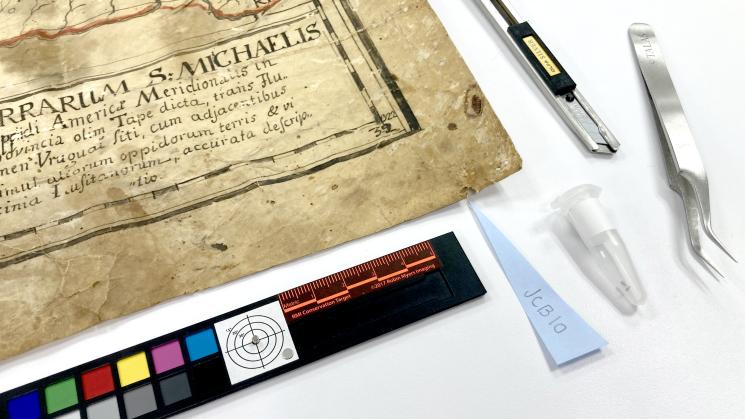
The JCB’s Roger Shaw Williams provides insight into how essential conservation process and practice are for sharing rare materials. As we closed one exhibit and opened another, work is already beginning for the next.
Exhibits are a valuable use of the collections in a research library such as the JCB. They are among the most efficient ways to gain exposure to rare collections. They are an opportunity for creative and unique interpretation. And they give materials a chance to be in conversation with one another. In the case of our current exhibit, “1776 Across the Americas,” the materials on display form a snapshot of what was happening across the Western Hemisphere during that eminent year.
As with any physical use, exhibits also pose a risk of damage to rare materials. Exhibits require additional handling during examination by curators, catalogers, and digitization specialists. While on display, they are exposed to light for extended periods. The position in which materials sit for long periods can also cause damage.
Additionally, we want the collections on display to appear well cared for. There are thousands of items with damage in the stacks of any special collections library; being selected for exhibit means an object gets priority for treatment before it goes “on stage.”
With all of this in mind, it is no surprise that the JCB conservation department plays a critical supportive role in the (surprisingly long!) process of creating each exhibit.
Assessing and Preparing for Display
As soon as the curators select a list of items for an exhibit, the conservation team conducts a thorough condition assessment. Each book, manuscript, or print is examined to consider vulnerabilities and prior damage.
Based on this assessment, conservators make display recommendations tailored to the needs of each material: choices about whether an item can safely be on view, how it should be positioned or supported, and what protective measures are necessary to slow deterioration.
Certain features (like hand-applied watercolors or degraded paper) are particularly light-sensitive, and the conservator may recommend swapping the original item out with a facsimile to minimize exposure. Some types of damage (like a paper tear or a loose bookboard) are quick and easy to fix. Other extensive damage can make an item difficult to display, and the conservator may recommend finding a replacement.
The conservation team can make delicate repairs to stabilize fragile areas and restore functionality (e.g., enabling a bound volume to open safely), while balancing the need to preserve authenticity.
Custom Supports
The conservation team carefully plans the mounting of each exhibit item. Some, like a flat map, are straightforward. Others, like a bound book that contains a large fold-out print the curator would like displayed, require more engineering. We aim to strike a balance between custom accommodation and the reuse of materials to reduce waste. A cold-bendable plastic called PETG is used along with recyclable archival matboard to support fragile materials during their long display time.
Material Interpretation
For our recently closed exhibit, “Elemental: Crafting Books from Nature,” the conservation department's work went beyond preservation and into research and interpretation. Because that exhibit focused on the collection’s physical materials, understanding what they are and where they come from deepens visitors’ appreciation of each object’s history.
To that end, we took very small samples from the leather and parchment of several books. These fragments were sent for a scientific analysis known as Peptide Mass Fingerprinting (PMF). In this method, collagen (the structural protein in animal skins) is enzymatically digested into peptides; the masses of these peptides are measured via mass spectrometry and then compared against databases of known protein sequences to identify the species of animal from which the skin is derived—calf, goat, sheep, etc. That information can provide insight into past bookbinding practices and trade routes for materials, thus enriching our researchers’ interpretations of the JCB collections.