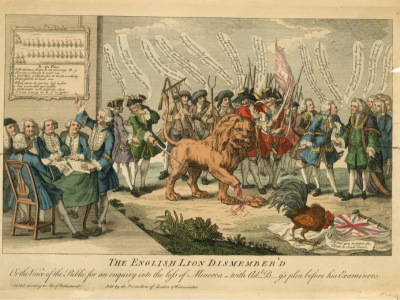
The English Lion Dismember'd, 1756
Our new exhibition, 1776 Across the Americas, which opened January 30, will now remain open for the full year. The semiquincentennial of the American declaration of independence from Great Britain is a fresh opportunity to reflect on the important histories of 1776 and beyond, and for the JCB to leverage its distinctive collections and capacity in the service of wider engagement with this critical period. Our emphasis in the exhibition, and one of the three themes of our work to mark this anniversary, is the hemispheric context, in which 1776 was a year that was consequential for people across the Americas for different reasons. That year landed in a fully global context, and the American war came out of and reverberated into further global conflicts.
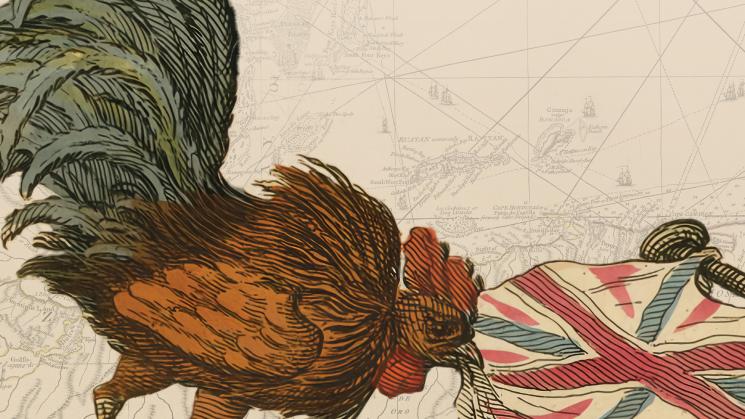
The central image in the exhibition promotional materials reflects the deeper and global history of the American war for independence, as well as the many forms of memory that shape our understanding of the period. We chose to spotlight a corner feature, in which a rooster is tearing a British flag. That selection echoes the Rhode Island Red, the recognizable state bird of Rhode Island that was bred, like many histories of the revolution, decades after the war.
But of course the full image shows a fuller picture. This image is from 1756, so two decades earlier. And it reflects the intensity of the Seven Years’ War that was especially intense between the British and the French over their colonial claims in North America. In this image printed in London, it is actually the French rooster who is destroying the British flag, and the British lion who has lost a paw (and has a bleeding forelimb).
Yet by the end in 1763, the French were not victorious in this war; the British won, as much as any empire could fully wrest territory from another–or from Indigenous peoples. And it was the commitments of all kinds that they made–financial, military, and political–to try and manage their vast new claims in North America that would help set up the revolutionary conflict decades later.
At any given moment our perspectives are always informed by where we are, and where we think we’ve been. This was no less true in 1776, and we embrace the breadth of perspective this wonderful image provides.
(Image link: https://americana.jcblibrary.org/search/object/jcbcap-ljcbmaps-2-2-202-100048/)